
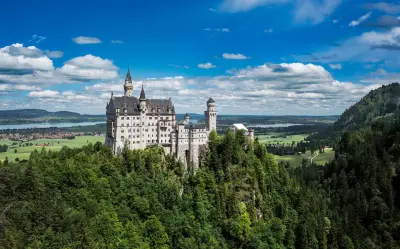
NEUSCHWANSTEIN CASTLE INSIDE
Neuschwanstein Castle History & Architecture
Neuschwanstein Castle history & architecture
Neuschwanstein Castle, one of the most famous landmarks in Bavaria, Germany, was built in the late 19th century by King Ludwig II of Bavaria. Designed as a romantic medieval-style retreat, it was inspired by medieval legends, myths, and the operas of Richard Wagner, whom Ludwig greatly admired.
Built in a dramatic mountain setting, the castle resembles something from a fantasy, reflecting Ludwig’s dreamlike architectural vision. Its design blends Romanesque, Gothic, and Byzantine architectural elements, creating a fairy-tale appearance. Though never fully completed after Ludwig’s mysterious death in 1886, Neuschwanstein has become one of the most visited castles in the world, attracting millions of visitors each year.

The name
Neuschwanstein Castle got its name from the nearby Schwanstein Castle (now called Hohenschwangau Castle), the childhood home of King Ludwig II of Bavaria in the village of Hohenschwangau. Originally, Ludwig II planned to name it “Neue Burg Hohenschwangau” (New Castle of Hohenschwangau), but after his death, it was renamed Neuschwanstein, meaning “New Swan Stone”. The name reflects Ludwig’s love of swans, symbols of purity, and their connection to the Swan Knight Lohengrin from Wagner’s opera. Ludwig greatly admired composer Richard Wagner, and his works significantly influenced the castle’s design and themes. Today, Neuschwanstein stands as a symbol of his imagination and the artistic legacy he left behind.

The dreamlike world of Ludwig II of Bavaria
King Ludwig II of Bavaria, known as the “Fairy Tale King”, ruled from 1864 to 1886 as a politically isolated monarch who prioritized art and architecture over governance. A visionary dreamer and patron of the arts, he built Neuschwanstein Castle, Linderhof Palace, and Herrenchiemsee Palace as extravagant retreats inspired by medieval legends and themes from Richard Wagner’s operas. His extravagant castle projects led to financial troubles and political tensions. In 1886, he was declared mentally ill without proper examination, a diagnosis some believe was politically motivated to remove him from power. He was declared unfit to rule and was removed from power, with his uncle Prince Luitpold taking over as regent. Shortly after, he was found dead in Lake Starnberg under mysterious circumstances, with theories of drowning or assassination still debated.

Ludwig II and his castles
Personal retreats and inspirations: King Ludwig II built his castles as personal retreats, escaping political pressures to create a world inspired by medieval legends, Richard Wagner’s operas, and French architecture. He saw them as more than homes; they were expressions of his love for art, mythology, and absolute monarchy.
The castles:
Neuschwanstein Castle – A fairy-tale fortress in the mountains inspired by medieval legends and Wagner’s operas.
Linderhof Palace – A small but lavish palace with French-style gardens, reflecting his admiration for Louis XIV and Versailles.
Herrenchiemsee Palace – An unfinished replica of Versailles, built to honor the Sun King and absolute monarchy.
Funding and cultural aspirations: Ludwig funded these projects using his personal wealth and money from the Welfenfonds. Inspired by Château de Pierrefonds, Versailles, and Wartburg, he wanted to celebrate Bavarian culture through architecture, art, and music.
Economic impact and legacy: His castles also boosted local economies, creating jobs in remote areas. Though costly and controversial during his reign, they are now among Germany’s most famous landmarks.
Want to learn more about Neuschwanstein Castle? Book our guided tour or ticket now!

Live Tour Guide
Neuschwanstein & Linderhof Tour
Experience the perfect mix of history, beauty, and nature on a tour from Munich through Germany's countryside. Visit the beautiful Neuschwanstein Castle, a real-life fairy-tale castle built by King Ludwig II of Bavaria. Explore the castle's interior and enjoy a peaceful walk through the surrounding forest with the spectacular panorama of mountains. On this day trip from Munich, you'll also have an opportunity to visit Linderhof Castle and Ludwig II's childhood home in the scenic village of Hohenschwangau.

skip the line ticket
Neuschwanstein Castle Skip-the-line Ticket Tour
Visit Neuschwanstein Castle and see a castle straight out of a fairytale! It was inspired by medieval architecture and features many works of art inspired by Wagner's operas. Your guide inside the castle will tell you all the most interesting information about it. Discover the luxury and opulence of the castle, and admire the stunning views!

Neuschwanstein: The Swan King’s Ultimate Fantasy
King Ludwig II spent much of his childhood at Hohenschwangau Castle, near Füssen, Bavaria, where he first fell in love with the surrounding mountains and medieval romance. This castle, built by his father, King Maximilian II, was decorated with murals presenting medieval legends, which greatly influenced Ludwig’s imagination. Inspired by medieval legends, chivalry, and Richard Wagner’s operas, he dreamed of creating a fairy-tale castle reflecting his artistic and fantasy-driven world.
Schloss Neuschwanstein was the first castle he planned, with designs commissioned in 1868. While work on Herrenchiemsee began later, Neuschwanstein remained his most ambitious project, reflecting his love for medieval romance and Wagnerian opera. Unlike real medieval fortresses, Neuschwanstein was meant to be a romantic retreat, blending Romanesque, Gothic, and Byzantine architectural styles. Ludwig had imagined building a castle on this mountaintop since childhood, and construction finally began in 1869.

The construction of Neuschwanstein Castle: A timeline
The idea and planning (1868 – 1869): King Ludwig II envisioned a fairy-tale castle inspired by medieval legends and Wagner’s operas. He chose a mountaintop above Pöllat Gorge, near his childhood home, Hohenschwangau Castle, for its construction. In 1868, the ruins of existing medieval twin castles on the site were demolished to prepare for the new foundation. Architect Eduard Riedel designed the plans, with Ludwig II actively influencing the design to match his vision.
Laying the foundation (1869 – 1873): Construction began on September 5, 1869, with the laying of the foundation stone. The initial phase involved significant site preparation, including removing up to 8 meters of stone to establish a stable foundation. Unlike real medieval castles, which were built for defense, Neuschwanstein was designed purely as a romantic retreat. The castle’s foundation and structure were built using modern 19th-century techniques, including brick walls covered in limestone and reinforced beams for support. The Gateway Building (gatehouse) was the first structure completed in 1873 and served as Ludwig’s residence during the ongoing construction of the main castle.

Building the main castle (1874 – 1880): From 1874 onwards, the focus shifted to the main structure, known as the Palas. The completion of the structural framework was celebrated in 1880 with a topping-out ceremony. The design incorporated Romanesque Revival architecture, with interiors decorated with frescoes presenting scenes from Wagner’s operas and medieval legends. Construction experienced delays due to Ludwig’s evolving design preferences and financial constraints.
Near completion and Ludwig’s death (1881 – 1886): By 1881, major parts like the Singers’ Hall and Ludwig’s bedroom were completed, but the throne room remained unfinished. Although the castle was designed to have over 200 rooms, only about 15 rooms were completed before the king’s death. In 1886, Ludwig was declared mentally unfit and removed from power. Days later, he died under mysterious circumstances, and construction stopped.
Public opening and restoration (1886 – present): Soon after Ludwig’s death, the castle was opened to the public to recover costs. Over time, it became one of the most famous castles in the world, inspiring Disney’s Sleeping Beauty Castle and attracting millions of visitors each year.

A blend of architectural styles
Although designed to resemble a medieval castle, Neuschwanstein combines Romanesque, Gothic, and Byzantine elements. Its style reflects the 19th-century architectural trend, where architects drew inspiration from multiple historical periods. The exterior’s towering spires and white limestone walls create a fairy-tale appearance, while the lavish interiors include grand halls, intricate wood carvings, and colorful frescoes inspired by myths and Wagnerian opera. Despite its medieval look, the castle was equipped with modern 19th-century amenities, including central heating and running water.
Romanesque features: The castle’s design incorporates elements typical of Romanesque architecture, such as rounded arches and thick walls.
Gothic elements: The design includes pointed arches and towering spires, characteristic of Gothic architecture.
Byzantine influences: The Throne Room’s design is inspired by Byzantine architecture, featuring domes and arches.

The Throne Hall
One of the most spectacular rooms in the castle is the Throne Room, designed to resemble a Byzantine church. It is spread across two floors and features a high ceiling, colorful arches, and a large chandelier shaped like a crown. At one end, there’s a platform intended for a throne, symbolizing King Ludwig II’s royal authority, but the throne was never built. The walls display religious paintings blending religious and royal themes, and the floor presents detailed mosaic designs.
The Singers’ Hall
The Singers’ Hall in Neuschwanstein Castle was completed during King Ludwig II’s lifetime and was one of his favorite projects. Located on the fourth floor, it was inspired by the Hall of the Singers and Ballroom at Wartburg Castle. Decorated with themes from Wagner’s operas “Lohengrin” and “Parzival”, it honored medieval culture and chivalry. Unlike traditional halls, it was not meant for court festivities but as a symbolic tribute to knights and courtly love. The first performance there occurred in 1933, marking the 50th anniversary of Wagner’s death.

King Ludwig’s bedroom
King Ludwig II’s bedroom in Neuschwanstein Castle reflects his love for medieval legends and Gothic architecture. The room features detailed paintings and carvings of the story of Tristan and Isolde. It also includes the neo-Gothic bed, with a canopy that fourteen woodcarvers crafted over four years. The blue silk walls are decorated with embroidered symbols, including lions, swans, crowns, lilies, and the Bavarian coat of arms. Next to the bedroom is a small chapel dedicated to Saint Louis IX, the French king and Ludwig’s namesake. This chapel highlights Ludwig’s appreciation for Gothic art and architecture.
A technological masterpiece of its time
Despite its medieval look, Neuschwanstein was highly advanced for its time. It had running water, central heating, a telephone line, and even an automatic flushing system. The castle also had an electric bell system for calling servants and telephones on the third and fourth floors. The kitchen was equipped with modern innovations, and meals were transported via a lift from the kitchen to the dining rooms.

Walt Disney’s Sleeping Beauty Castle
Neuschwanstein became world-famous in the 20th century when Walt Disney used it as inspiration for Sleeping Beauty Castle in Disneyland. Its fairy-tale appearance and dramatic location make it one of the world’s most recognizable and visited castles.
The view from Marienbrücke
Marienbrücke (Mary’s Bridge) was initially built in 1845 by King Maximilian II to connect Hohenschwangau Castle with the surrounding area. However, it was under King Ludwig II that the bridge was reinforced in 1866, as he intended to improve its stability and aesthetic appeal. Positioned high above the Pöllat Gorge, the bridge offers a strategic vantage point of Neuschwanstein Castle, reflecting Ludwig’s vision of blending natural beauty with architectural grandeur.
A Castle without its king
Ludwig II only lived in Neuschwanstein for a few months before he was declared insane and deposed in 1886. Shortly after, he died under mysterious circumstances, and construction on the castle stopped. Within weeks, the castle was opened to the public, and today, it attracts millions of visitors each year. During summer months, up to 6,000 people visit the castle, which was initially designed for just one person. While Neuschwanstein’s location is stunning, the foundation and rock walls need constant monitoring and reinforcement, along with ongoing renovation of the limestone facade.
Don’t miss our best-value Neuschwanstein Castle ticket & tour deals!
Live Tour Guide
Neuschwanstein & Linderhof Tour
Experience the perfect mix of history, beauty, and nature on a tour from Munich through Germany's countryside. Visit the beautiful Neuschwanstein Castle, a real-life fairy-tale castle built by King Ludwig II of Bavaria. Explore the castle's interior and enjoy a peaceful walk through the surrounding forest with the spectacular panorama of mountains. On this day trip from Munich, you'll also have an opportunity to visit Linderhof Castle and Ludwig II's childhood home in the scenic village of Hohenschwangau.
skip the line ticket
Neuschwanstein Castle Skip-the-line Ticket Tour
Visit Neuschwanstein Castle and see a castle straight out of a fairytale! It was inspired by medieval architecture and features many works of art inspired by Wagner's operas. Your guide inside the castle will tell you all the most interesting information about it. Discover the luxury and opulence of the castle, and admire the stunning views!